INSIGHTS | September 9, 2026

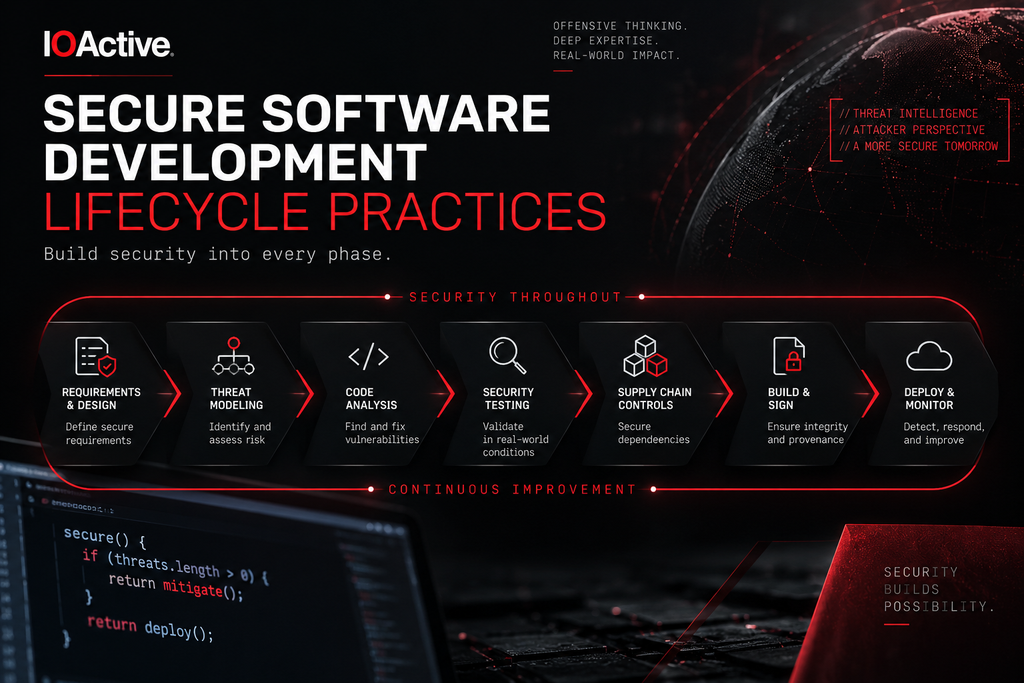
Secure Software Development Lifecycle Practices

IBM’s 2026 Cost of a Data Breach Report found the global average breach cost reached USD $4.99 million, a record high driven by AI-powered attacks up 56% year over year.¹ Supply chain attacks compound the exposure: ReversingLabs research confirmed software supply chain attacks grew 1,300% over three years.² The Log4j vulnerability alone generated over 10 million attack attempts per hour at peak exploitation.³ Organizations that treat security as a final-stage gate accumulate deferred risk with every release.

Secure software development lifecycle practices embed security controls at every phase of the software development process, reducing remediation costs and organizational risk.

“The most effective secure software development lifecycle practices address security before software is deployed, not after vulnerabilities are discovered.”
– IOActive Security Team

Secure SDLC Best Practices: Controls, Outputs, and Metrics

Best PracticeWhat It DoesKey OutputSuccess MetricsRisk If Skipped
Security Requirements MappingTranslates compliance and business requirements into testable acceptance criteria before development beginsDocumented security requirements and acceptance criteria% requirements with security acceptance criteria; compliance gap rateMissing controls, regulatory gaps, late-stage rework
Threat Modeling (STRIDE/DREAD)Identifies attack paths in planned architecture using structured frameworks before a line of code is writtenThreat register, attack surface map# threats identified per review; % mitigated before development startsArchitectural flaws reach production with costly remediation
Static Code Analysis (SAST)Scans source code for insecure patterns at commit or build timeClean code reports, flagged findings# high/critical findings per 1,000 lines of code; mean time to remediateInjection flaws, hardcoded secrets, insecure patterns shipped
Dynamic Application Security Testing (DAST)Tests running applications against real attack patterns pre-releaseValidated vulnerability findings# runtime vulnerabilities found; % of API endpoints testedRuntime and authentication flaws missed before release
Software Composition Analysis (SCA) + SBOMInventories open-source dependencies and tracks known CVEs; SBOM documents every component in the buildCVE inventory, Software Bill of Materials% dependencies on a supported version; # libraries no longer actively maintainedVulnerable third-party libraries deployed; supply chain exposure
Artifact Signing and Configuration HardeningSigns build artifacts cryptographically and audits deployment configurations to prevent tamperingSigned artifacts, hardened deployment configurations% of artifacts signed; # misconfigurations resolved at deploy gateSupply chain tampering, misconfigured production environments
Vulnerability Management and SLA EnforcementPrioritizes and remediates vulnerabilities by CVSS score, production reachability, and CISA KEV statusRemediated CVE backlog, SLA compliance metricsMean time to remediate (MTTR) by severity tier; % SLA complianceUnpatched known-exploited vulnerabilities accumulate and expand breach risk
Security Governance and Program MaturityEstablishes named ownership, enforceable security gates, and maturity benchmarks aligned to NIST SP 800-218 or OWASP SAMMMaturity score, named control owners, audit evidence# controls with named owners; % security gates enforced in CI/CD; maturity level progressionControls exist on paper only; programs consistently underperform without governance infrastructure

Gaps at any single phase propagate forward. A vulnerability introduced at requirements and missed through design, development, and testing arrives in production fully formed and significantly more expensive to remediate.

Run Threat Modeling Before Writing Code

The highest-leverage security activity happens before a single line of code is written. Threat modeling, using frameworks such as STRIDE or DREAD, gives teams a structured method for identifying attack paths in planned architecture and building in controls before architectural decisions become costly to reverse. A research-fueled Secure Development Lifecycle engagement brings genuine adversarial thinking to this process, applying real-world offensive experience to surface the systemic risks that automated tools routinely overlook.

Threat Modeling Method Comparison

MethodWhat It DoesWho Runs ItWhat It ProvidesEffort LevelBest Fit
STRIDECategorizes threats by class: Spoofing, Tampering, Repudiation, Information Disclosure, Denial of Service, Elevation of PrivilegeSecurity architects, senior developersComprehensive attack class mapping across trust boundariesMedium — 1 to 2 days per system reviewApplication architecture and trust boundary analysis
DREADScores threats on Damage, Reproducibility, Exploitability, Affected users, and Discoverability to produce a ranked risk listSecurity engineers, risk teamsPrioritized threat list by exploitability and business impactLow to medium — hours per threat registerRisk-ranking identified threats for remediation sequencing
Attack TreesDecomposes the path to a specific high-value target into branches of possible attack methodsPenetration testers, security researchersTargeted attack path analysis for critical or high-value componentsHigh — days to weeks for complex targetsComponent-level analysis of specific high-value targets

Method selection depends on the question the team needs to answer. STRIDE maps attack classes broadly across a system; DREAD narrows findings to prioritized risk; Attack Trees decompose the path to a specific high-value target. Most mature programs apply more than one method, selecting based on the architecture under review and the risk questions at hand.

Integrate Code Analysis and Supply Chain Controls Into Every Pipeline Stage

Static analysis (SAST) catches insecure code patterns during development, while dynamic testing (DAST) validates a running application against real attacker behavior. Supply chain exposure requires its own layer of controls. Sonatype’s research found open-source supply chain attacks growing at 742% annually. A dedicated Supply Chain Integrity assessment applies attacker-mindset analysis from silicon through the application layer. A 2025 third-party assessment of Microsoft’s Signing Transparency service confirmed strong implementation security and identified defense-in-depth improvements. Core controls include SBOM management, SCA in CI/CD pipelines, dependency pinning, and artifact signing.

Code Analysis and Supply Chain Controls

ControlWhat It DoesWho Runs ItIntegration PointRisk Addressed
SAST in CI/CDScans source code for insecure patterns automatically at commit or mergeDeveloper pipelines, security championsGit pre-commit hook or CI pipelineInsecure patterns caught before code reaches the main branch
DAST pre-releaseSends attack traffic to a running application to surface runtime flawsQA teams, security engineersStaging environment or pre-release gateRuntime and authentication flaws not visible to static analysis
SCA in build pipelineScans open-source dependencies against CVE databases with each buildDevOps, security teamsBuild pipeline or dependency resolution stepKnown CVEs in third-party libraries before they reach production
SBOM + artifact signingGenerates a complete bill of materials and cryptographically signs build outputs for every releaseDevSecOps, release engineeringRelease pipeline or deployment gateSupply chain tampering and untracked third-party components

Layering all four controls closes distinct gaps at different pipeline stages. SAST and DAST address first-party code at different points in the lifecycle. SCA and SBOM management address third-party and supply chain risk at the build and release stages. Each layer reinforces the others: SAST catches what code review misses, DAST catches what SAST cannot see at runtime, and SCA flags risks that originate entirely outside the team’s codebase.

Prioritize Vulnerabilities With Contextualized SLA Frameworks

Datadog’s 2025 DevSecOps research found that the median software dependency is 215 days behind its latest major version, with one in two services running libraries no longer actively maintained. Effective vulnerability management requires contextualized prioritization based on CVSS score and production reachability, SLA-based ownership, and regression testing to confirm fixes hold. Listings on the CISA Known Exploited Vulnerabilities catalog indicate confirmed real-world exploitation and warrant accelerated remediation timelines regardless of the base CVSS score.

Vulnerability Remediation SLA Framework

Priority TierCriteriaTarget SLA
CriticalCVSS 9.0+, internet-exposed, CISA KEV listed24–72 hours
HighCVSS 7.0–8.9, production reachable7–14 days
MediumCVSS 4.0–6.9, limited exposure30–60 days
LowBelow 4.0 or non-production90 days

SLAs paired with named ownership and enforced timelines convert a priority framework into a functioning remediation program. Without that operational infrastructure, vulnerability backlogs expand faster than teams can close them.

Establish Named Ownership and Track Security Program Maturity

Governance gaps are the most common point of failure in secure SDLC programs. Controls require named ownership and enforceable gates; programs without both consistently underperform regardless of tooling investment. The NIST Secure Software Development Framework (SP 800-218) and OWASP SAMM provide structured maturity models for building and measuring program progress. Red Team and Purple Team exercises close the feedback loop, testing whether development-phase controls hold under real adversarial simulation and informing the next cycle of program improvement.

Assess Your Current Maturity Level and Close the Gaps Systematically

Maturity LevelCharacteristicsNext Steps to Advance
Ad HocReactive, no formal process, incident-driven patchingAssign one control owner per business unit; document current state versus target state; implement a vulnerability tracking system
DefinedBasic security gates, SAST in CI/CD, vulnerability trackingAdd threat modeling at the design phase; adopt SLA-based remediation; integrate SCA into the build pipeline
ManagedThreat modeling, SCA, SLA-driven remediation, metrics reportingAutomate artifact signing; run quarterly adversarial simulations; establish an SBOM management program
OptimizedAutomated supply chain controls, adversarial simulation, SBOM managementIntegrate continuous Red Team feedback into the SDLC; benchmark the program annually against NIST SP 800-218 or OWASP SAMM

Most organizations enter at Ad Hoc or Defined. Identifying the gaps between the current state and the next level, then addressing them incrementally, produces durable outcomes. Each level builds on the controls established in the previous one, making systematic progression the most reliable path to program improvement.

Build Security Into Your Development Process With IOActive

Secure software development lifecycle practices address vulnerabilities at the phase where remediation is most efficient: before the code ships. Organizations that build security into design, development, and deployment produce software that holds up under real-world adversarial pressure and satisfies the compliance obligations regulators and insurers continue to tighten. IOActive’s 25+ years of research-driven assessments, landmark vulnerability disclosures, and straight-talk approach give clients an honest picture of where their program creates risk.

Sources

  1. IBM Security. Cost of a Data Breach Report 2026. https://www.ibm.com/reports/data-breach
  2. ReversingLabs. The State of Software Supply Chain Security 2024. https://www.reversinglabs.com/sscs-report-2024
  3. IOActive. Supply Chain Integrity. https://www.ioactive.com/service/supply-chain-integrity/
  4. Sonatype. State of the Software Supply Chain, 10-Year Look. 2024. https://www.sonatype.com/state-of-the-software-supply-chain/2024/10-year-look
  5. IOActive. Security Assessment of Microsoft’s Signing Transparency. 2025. https://www.ioactive.com/wp-content/uploads/2025/10/Microsoft-Signing-Transparency-Service-Security-Assessment-IOActive-Public-Facing-Report.pdf
  6. Datadog. State of DevSecOps 2025. April 2025. https://www.datadoghq.com/state-of-devsecops-2025/
  7. NIST. Secure Software Development Framework (SSDF) SP 800-218. https://csrc.nist.gov/projects/ssdf
INSIGHTS | August 10, 2026

When the Advisory Arrives First: Minnesota’s Water Utilities and the Limits of Warning

Key Takeaways

  • More than 30 Minnesota community water systems were targeted across July 26 and 27, 2026 in what Minnesota IT Services (MNIT) has characterized as a coordinated cyberattack. Automated control functions were affected at several utilities, and the City of Braham briefly took its water treatment plant offline [4][6][9].
  • No attribution has been made. Officials have not named a threat actor, identified an exploited vulnerability, confirmed which products were affected, or established whether data was taken [4][7].
  • The incidents followed four days after the July 22 update to joint advisory AA26-097A, which widened observed Iranian-affiliated targeting of internet-facing programmable logic controllers (PLCs) from Rockwell Automation equipment to include Schneider Electric and Siemens devices [1][3].
  • The City of Plymouth reported that impact was confined to equipment reached over cellular links. Remote assets — water towers, lift stations, pump stations — frequently sit outside the boundary of formal risk and vulnerability assessments [4][10].
  • The consequence class here is loss or manipulation of view and control, not data loss. Operators in the UK and Europe carry equivalent exposure, under a regulatory regime that is tightening as the UK Cyber Security and Resilience Bill progresses through Parliament [16].

Why This Incident Matters Now

A joint advisory told critical infrastructure operators, in specific terms, that state-linked actors were reaching internet-facing PLCs at water and wastewater utilities and manipulating what those controllers do. Four days later, more than 30 water systems in a single US state reported disrupted automated controls over a 48-hour period.

Whether the two events are connected has not been established publicly, and this analysis does not assume they are. The more useful question for security leaders is what the sequence reveals about the distance between a warning being issued and a warning being actioned. Advisory AA26-097A has been in circulation since April 7, 2026 [1]. Its July update did not describe a novel technique. It broadened the list of affected manufacturers and added detection guidance. For any operator running an internet-reachable controller from one of the named vendors, the required response was already documented, already free, and already several months old.

The Minnesota incidents are therefore worth examining less as a novel threat and more as a measurement of how much of the sector is positioned to act on advisories at the speed at which they are now being issued.

What Actually Happened in Minnesota

MNIT confirmed that more than 30 community water systems were targeted on July 26 and 27, 2026, and activated a statewide cybersecurity incident response [4][6][8]. The agency is coordinating with CISA, the Environmental Protection Agency (EPA), the FBI, state agencies and affected utilities [5][6]. The FBI has confirmed it is in contact with victims [6].

Four cities disclosed incidents publicly: Braham, Maple Plain, Plymouth and South St. Paul [4][9][10][11][12]. The reported pattern is consistent across them. Automated control functions were affected; contingency procedures were activated; in most cases water and wastewater operations continued. Braham took its treatment plant offline after detecting the incident and asked residents to limit water use, later reporting that the attackers had shut down operating controls, taking the well and treatment plant with them [4][9]. Maple Plain declared a local state of emergency to support its response [5][12]. South St. Paul reported that manual intervention by public works staff maintained normal operations despite the loss of some automated controls [4][11]. Plymouth attributed communications problems at two water towers and multiple lift stations to the incident, and stated that the impact was limited to equipment connected via cellular communications [4][10].

The affected cities have consistently informed residents that drinking water remains safe. MNIT stated on July 28 that it was aware of no active requests for residents to alter their water use [5].

Several material facts remain unpublished. MNIT has not released a full list of affected systems. No exploited vulnerability, affected product line or exfiltration finding has been made public. No actor has been named. Iranian-affiliated groups such as CyberAv3ngers and Handala fit the profile of the activity, and several outlets have noted the resemblance, but investigators have stressed that formal attribution has not been made [4][7]. Analysts should treat the attribution question as open.

What Changed in Advisory AA26-097A on July 22

Advisory AA26-097A was first published on April 7, 2026 by the FBI, CISA, the NSA, the EPA, the Department of Energy and US Cyber Command’s Cyber National Mission Force. It documented Iranian-affiliated advanced persistent threat (APT) actors exploiting internet-connected operational technology (OT) devices across the Government Services and Facilities, Water and Wastewater Systems, and Energy sectors, with confirmed disruption at victim organizations since at least March 2026 [1][2].

The July 22 update made three substantive changes [1][2][3].

Manufacturer Scope Widened

Observed targeting now extends beyond Rockwell Automation and Allen-Bradley controllers to Schneider Electric and Siemens PLCs, and potentially other branded devices. Specific models are named in the advisory, including Rockwell CompactLogix and Micro850, Schneider Modicon M340, and the Siemens S7-1200 series [3].

Detection Guidance for Reusable Code Modules

The update adds guidance on identifying malicious modifications to reusable logic — Add-On Instructions within Rockwell programs, for example — including validating project files and comparing running logic against a known-good baseline [3].

A Refreshed Indicator Set and a New Co-Authoring Agency

The update publishes a refreshed set of indicators of compromise, and the Department of the Treasury is added as a co-authoring agency [1][17].

The access method described in the advisory is the part that should concern operators most, because it is not a vulnerability in the conventional sense. Actors reach internet-exposed controllers from leased overseas hosting infrastructure and connect using the manufacturers’ own engineering software — Studio 5000 Logix Designer, EcoStruxure Control Expert, TIA Portal — the same tooling legitimate engineers use [1][3]. Connections made this way are difficult to separate from authorized administrative activity. From there, the advisory documents modification of control logic, disabling of alarm and shutdown functions, and alteration of data presented on operator displays [3].

Water and Wastewater Systems is named explicitly among the targeted sectors, and internet-exposed PLCs remain the primary access point [3].

Who Is Affected by Internet-Exposed OT?

US Water and Wastewater Operators

The sector’s risk profile varies enormously by resource level. Large municipal utilities often run segmented networks, dedicated security staff and formal asset lifecycle management. Most community water systems are small municipal utilities or rural cooperatives, some serving only a few hundred customers, without dedicated cybersecurity personnel or continuous monitoring [14]. A technique that a well-resourced utility would contain quickly can cause prolonged operational impact in a small system. The EPA leads federal water sector cybersecurity efforts but has no explicit statutory authority to mandate cybersecurity measures, relying on voluntary engagement and technical assistance [15].

UK and European Operators

Drinking water is an in-scope sector under the UK’s NIS Regulations 2018, and the UK Cyber Security and Resilience (Network and Information Systems) Bill would expand obligations, incident reporting requirements and regulatory powers across those sectors [16]. The Bill received its second reading in the House of Lords on July 14, 2026 [16]. The technical exposure is not materially different: the same vendors, the same engineering tooling, and the same practice of reaching remote assets over public networks.

Critical National Infrastructure (CNI) Operators in Other Sectors

Energy and government facilities are named alongside water in AA26-097A. Any organization running the named controller families in an internet-reachable configuration is within the described targeting scope, regardless of sector [1][3].

System Integrators and OT Suppliers

Where control system architecture is delivered by an integrator, the connectivity decisions — including secondary and backup communication paths — are frequently made outside the asset owner’s direct visibility. Under the Cyber Security and Resilience Bill, suppliers to regulated entities face obligations of their own [16].

What Are the Practical Challenges for Operators?

Remote Assets Are the Architecture’s Blind Spot

Plymouth’s disclosure that impact was limited to cellular-connected equipment is the most operationally instructive detail released so far. Water towers, lift stations and pump stations commonly report back to supervisory control and data acquisition (SCADA) systems over cellular modems, and these secondary or alternative communication links are routinely omitted from risk and vulnerability assessments [4]. This is not a new failure mode. In the 2020 attacks on Israeli water facilities, actors linked to the Iranian government used vulnerable cellular routers as the point of entry [4]. An assessment scoped to the plant boundary will not find a modem on a tower six miles away.

The Relevant Consequence Is Not Data Loss

In MITRE ATT&CK for industrial control systems (ICS) terms, the consequences at stake are denial or loss of view, denial or loss of control, and manipulation of view or control [4]. A physical process can continue running while operators lose the ability to see or influence it. Manipulation is the more dangerous case, because the process may be in a state that differs from what the screens report — precisely the scenario AA26-097A describes when it documents altered operator display data [1][3]. Detection strategies built around data exfiltration will not register any of this.

Advisory Volume Exceeds Absorption Capacity

Four days is a short interval between an advisory update and a sector-wide incident, but the underlying advisory was nearly four months old. The constraint is not awareness. It is the engineering time to inventory controllers, establish logic baselines, remove internet exposure and rehearse manual operation — work that competes with statutory obligations for water quality, capital works and day-to-day service delivery.

Attribution Absorbs Attention That Belongs Elsewhere

Whether the Minnesota incidents prove to be Iranian-affiliated changes very little about the required response. The controls that reduce exposure to this activity are the same controls regardless of who is behind it, and waiting for attribution before acting concedes time to the adversary.

How IOActive Can Help

IOActive’s work in critical infrastructure spans the technical and strategic worlds of OT and ICS security, from the semiconductor inside a controller to the governance program around it. Our team has operated in ICS environments since building the first proof-of-concept worm against the smart grid in 2009 [20], and has helped define standards and best practices including NIST 800-53 and 800-37. The two gaps this incident exposes are assessment problems before they are tooling problems: assessment scope that stops at the plant boundary and misses remote, cellular-connected assets, and the absence of an authoritative baseline against which controller logic can be validated. The services below address each directly.

Full Stack Security Assessments

Most providers scan at the network or application layer only. Our Full Stack Security Assessments examine the entire environment, drilling down to the facility and silicon level and up through the personnel, process, and supply-chain layers around it. For a water or wastewater operator, that means scoping to the whole estate rather than the plant boundary — the towers, lift stations and pump stations that report back over cellular modems, the OT/IT boundary, and the third-party managed links that are frequently the only route in. Drawing on our hardware research background, it also extends to the firmware and silicon of PLC and human-machine interface (HMI) devices themselves through penetration testing, reverse engineering, side-channel analysis, and fault injection. It is the same class of work behind our research Compromising Industrial Facilities from 40 Miles Away, which showed how a memory-corruption flaw in widely deployed industrial wireless automation devices could be exploited remotely to disable field sensor nodes — exactly the kind of remotely reachable field connectivity that Plymouth’s disclosure points to [18].

Red Team and Purple Team Services

Manipulation of view and control is the consequence class that matters here, and it is precisely what adversarial testing exists to surface. Our Red Team engagements emulate the tradecraft AA26-097A describes, including the “living off the land” use of vendors’ own engineering software in place of exploits, while our Purple Team work translates those findings into measurable improvements in whether your operators and analysts would actually detect unauthorized logic changes in time to act. It is the tabletop in step 6 below, run against the live environment rather than a whiteboard. IOActive research has repeatedly shown how attackers can blind the humans in the loop: our study SCADA and Mobile Security in the IoT Era found that more than 20% of the vulnerabilities identified across dozens of ICS mobile applications could let an attacker misinform operators or influence the industrial process directly [19].

Supply Chain Integrity

Where control system architecture is delivered by an integrator, connectivity decisions — including secondary and backup communication paths — are frequently made outside the asset owner’s visibility, and AA26-097A documents the vendors’ own configuration software being used as the access channel. Our Supply Chain Integrity service assesses the security posture of technology providers and critical third parties, reviewing firmware, embedded systems, remote-access arrangements, and procurement processes for inherited risk before it becomes an incident vector. Under the UK Cyber Security and Resilience Bill, suppliers to regulated entities will carry obligations of their own [16].

Secure Development Lifecycle

The advisory urges device manufacturers to adopt secure-by-default design rather than leaving operators to compensate for exposed controllers [1]. For the vendors and OEMs in the PLC, remote terminal unit (RTU) and HMI supply chain, our Secure Development Lifecycle work embeds security review into design and engineering — from threat modeling through code review and pre-release testing — so that the next generation of devices does not ship with the internet-reachable defaults this campaign depends on.

Advisory Services

Removing internet exposure is an architectural program, not a one-time patch, and there is no CVE here to wait for. Our Advisory Services — spanning programmatic security review, security program development and management, and Virtual CISO support — help water sector leaders and boards turn an advisory into a prioritized remediation plan, close the gap between a warning being issued and a warning being actioned, and prepare for the reporting obligations that arrive with an incident: Cyber Incident Reporting for Critical Infrastructure Act (CIRCIA) timelines in the US, and current and forthcoming NIS duties in the UK [15][16].

  1. Establish whether any controller is reachable from the internet. This means verification against the live estate, not a review of the network diagram. Include devices reached over cellular, satellite, radio and any third-party managed link, in line with the joint NCSC-UK, CISA and FBI secure connectivity principles for OT [13].
  2. Extend assessment scope to every remote asset. Towers, lift stations, pump stations and any site with an independent communications path. Where an integrator built the connectivity, request the full inventory of links in writing.
  3. Capture an offline logic and configuration baseline for every controller. This is both a detection capability and a recovery capability. Without it, comparing running logic to known-good logic — the core of the advisory’s new detection guidance — is not possible.
  4. Apply the AA26-097A mitigations directly. Remove direct internet exposure, change default credentials on PLCs and HMIs, enforce multi-factor authentication on all remote OT access, and enable controller key switches or run/program mode protections where the platform supports them [1][3].
  5. Ingest the refreshed indicators and hunt for engineering software activity. Look specifically for vendor engineering tooling running on hosts that are not designated engineering workstations, and for connections to controllers from unexpected sources [1].
  6. Rehearse the manipulation scenario, not the outage scenario. Run a tabletop in which operator displays report normal conditions while the process deviates. The exercise should establish how staff would detect the discrepancy, what independent instrumentation exists, and how manual operation would be initiated and sustained.
  7. Verify that incident reporting obligations are understood before they are triggered. For US utilities, CIRCIA reporting timelines; for UK operators, current and forthcoming NIS obligations under the UK Cyber Security and Resilience Bill [15][16].

Conclusion

The Minnesota utilities appear to have avoided serious consequences largely because staff reverted to manual operation and contingency plans held. That is a real result, and it reflects institutional competence that deserves acknowledgment. It is also a thin margin, and it depended on operators noticing that something was wrong.

The uncomfortable element of this incident is not that it happened without warning. It is that the warning was issued, updated, distributed through federal channels and sector information sharing and analysis centers (ISACs), and reported in the trade press — and the interval between that warning and disrupted controls in more than 30 communities was four days. Advisories are only a control if the organization receiving them has the capacity to act. For much of the water sector, on both sides of the Atlantic, that capacity is the constraint that needs addressing, and it will not be resolved by another advisory.

If you would like to discuss how your organization’s controller exposure and remote-asset connectivity measure up against the activity described here, or how IOActive can support your OT/ICS resilience program, we welcome the conversation.

References

[1] CISA, FBI, NSA, EPA, DOE, CNMF and US Department of the Treasury. Iranian-Affiliated Cyber Actors Exploit Programmable Logic Controllers Across US Critical Infrastructure (AA26-097A), published April 7, 2026, updated July 22, 2026. https://www.cisa.gov/news-events/cybersecurity-advisories/aa26-097a

[2] Internet Crime Complaint Center (IC3). Advisory AA26-097A (PDF), July 22, 2026. https://www.ic3.gov/CSA/2026/260722.pdf

[3] WaterISAC. (TLP:CLEAR) CISA Updates Iranian-Affiliated PLC Targeting Advisory (AA26-097A), July 2026. https://www.waterisac.org/tlpclear-cisa-updates-iranian-affiliated-plc-targeting-advisory-aa26-097a

[4] E. Kovacs. Dozens of Minnesota Water Utilities Targeted in Coordinated OT Attacks, SecurityWeek, July 29, 2026. https://www.securityweek.com/dozens-of-minnesota-water-utilities-targeted-in-coordinated-ot-attacks/

[5] Coordinated Cyberattack Targets 30+ Minnesota Water Systems as One Plant Goes Offline, The Hacker News, July 2026. https://thehackernews.com/2026/07/coordinated-cyberattack-targets-30.html

[6] Authorities investigating a coordinated cyberattack against Minnesota water systems, Cybersecurity Dive, July 28, 2026. https://www.cybersecuritydive.com/news/authorities-investigating-a-coordinated-cyberattack-against-minnesota-water/826427/

[7] Coordinated cyberattack disrupts water utilities in 30+ Minnesota communities, StateScoop, July 28, 2026. https://statescoop.com/coordinated-cyberattack-disrupts-water-utilities-in-30-minnesota-communities/

[8] Hackers target over 30 Minnesota water utilities in coordinated OT attack, BleepingComputer, July 29, 2026. https://www.bleepingcomputer.com/news/security/hackers-target-over-30-minnesota-water-utilities-in-coordinated-ot-attack/

[9] City of Braham. Cyber security incident statements, July 2026. https://brahammn.gov/

[10] City of Plymouth. News release, July 2026. https://www.plymouthmn.gov/Home/Components/News/News/8977/542

[11] City of South St. Paul. News release, July 2026. https://www.southstpaulmn.gov/m/newsflash/Home/Detail/900

[12] City of Maple Plain. Press Release: Cyber Security Incident, July 2026. https://www.mapleplainmn.gov/administration/page/press-release-cyber-security-incident

[13] NCSC-UK, CISA, FBI and international partners. Secure Connectivity Principles for Operational Technology, January 2026. https://www.cisa.gov/news-events/news/cisa-uk-ncsc-fbi-unveil-principles-combat-cyber-risks-ot

[14] Testimony before the US Senate Committee on Environment and Public Works. The Cybersecurity State of the Water Sector, February 4, 2026. https://www.epw.senate.gov/public/_cache/files/5/3/53d93dfe-ed8c-4e48-b705-0b16cb92c90a/FA38A32EE48D7F3D4B0C069FDC08A69E6327376EB85838A03310B2E91C8582C1.02-04-2026-dr.-simonton-testimony.pdf

[15] Nossaman LLP. Water Utilities: Congress Temporarily Extends Cyber Laws, EPA Releases New Guidance, November 2025. https://www.nossaman.com/newsroom-insights-water-utilities-congress-temporarily-extends-cyber-laws-epa-releases-new-guidance

[16] House of Lords Library. Cyber Security and Resilience (Network and Information Systems) Bill: HL Bill 32 of 2026–27, June 2026. https://lordslibrary.parliament.uk/research-briefings/lln-2026-0032/

[17] ComplianceHub. CISA Updates AA26-097A: Iranian-Affiliated PLC Targeting Widens to Schneider and Siemens, July 2026. https://compliancehub.wiki/cisa-aa26-097a-update-iranian-plc-targeting-critical-infrastructure-july-2026/

[18] IOActive. Compromising Industrial Facilities from 40 Miles Away (white paper). https://www.ioactive.com/wp-content/uploads/2018/05/IOActive_Compromising_Industrial_Facilities_from_40_Miles_Away.pdf

[19] IOActive (A. Bolshev, I. Yushkevich). SCADA and Mobile Security in the IoT Era. https://www.ioactive.com/scada-and-mobile-security-in-iot-era/

[20] M. Davis, IOActive. Advanced Metering Infrastructure (Smart Grid) Device Security, Black Hat USA 2009. https://blackhat.com/presentations/bh-usa-09/MDAVIS/BHUSA09-Davis-AMI-SLIDES.pdf

INSIGHTS | January 22, 2013

You cannot trust social media to keep your private data safe: Story of a Twitter vulnerability

I‘m always worried about the private information I have online. Maybe this is because I have been hacking for a long time, and I know everything can be hacked. This makes me a bit paranoid. I have never trusted web sites to keep my private information safe, and nowadays it is impossible to not have private information published on the web, such as a social media web site. Sooner or later you could get hacked, this is a fact.


Currently, many web and mobile applications give users the option to sign in using their Twitter or Facebook account. Keeping in mind the fact that Twitter currently has 200 million active monthly users (http://en.wikipedia.org/wiki/Twitter), it makes a lot of sense for third-party applications to offer users an easy way to log in. Also, since applications can obtain a wealth of information from your Twitter or Facebook account, most of the time you do not even need to register. This is convenient, and it saves time signing into third-party applications using Twitter or Facebook.


Every time I’m asked to sign in using Twitter or Facebook, my first thought is, “No way!”  I don’t want to give access to my Twitter and Facebook accounts regardless of whether I have important information there or not. I always have an uneasy feeling about giving a third-party application access to my accounts due to the security implications.


Last week I had a very interesting experience.

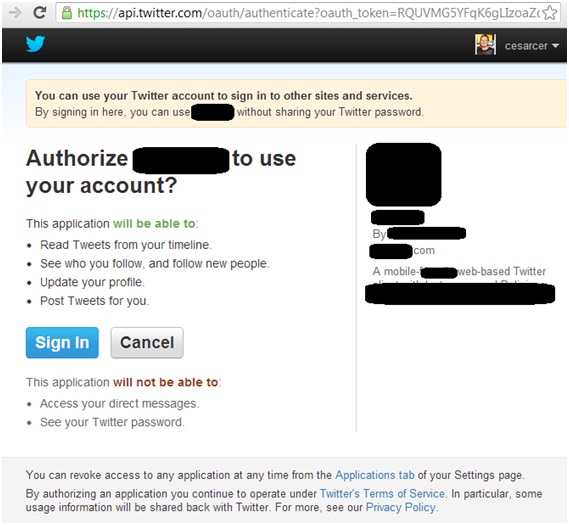
I was testing a web application that is under development. This application had an option to allow me to sign into Twitter. If I selected this option, the application would have access to my Twitter public feed (such as reading Tweets from my timeline and seeing who I follow). In addition, the application would have been able to access Twitter functionality on my behalf (such as following new people, updating my profile, posting Tweets for me). However, it wouldn’t have access to my private Twitter information (such as direct messages and more importantly my password). I knew this to be true because of the following information that is displayed on Twitter’s web page for “Signing in with Twitter”:


Image 1


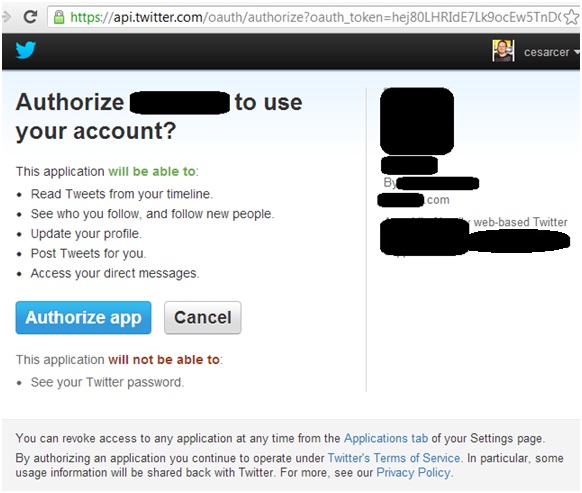
After viewing the displayed web page, I trusted that Twitter would not give the application access to my password and direct messages. I felt that my account was safe, so I signed in and played with the application. I saw that the application had the functionality to access and display Twitter direct messages. The functionality, however, did not work, since Twitter did not allow the application to access these messages. In order to gain access, the application would have to request proper authorization through the following Twitter web page:


  Image2


The web page displayed above is similar to the previous web page (Image 1). However, it also says the application will be able to access your direct messages. Also, the blue button is different. It says “Authorize app” instead of “Sign in”. While playing with the application, I never saw this web page (image 2). I continued playing with the application for some time, viewing the functionality, logging in and out from the application and Twitter, and so on. After logging in to the application, I suddenly saw something strange. The application was displaying all of my Twitter direct messages. This was a huge and scary surprise. I wondered how this was possible. How had the application bypassed Twitter’s security restrictions? I needed to know the answer.


My surprise didn’t end here. I went to https://twitter.com/settings/applications to check the application settings. The page said “Permissions: read, write, and direct messages”. I couldn’t understand how this was possible, since I had never authorized the application to access my “private” direct messages. I realized that this was a huge security hole.


I started to investigate how this could have happened. After some testing, I found that the application obtained access to my private direct messages when I signed in with Twitter for a second or third time. The first time I signed in with Twitter on the application, it only received read and write access permissions. This gave the application access to what Twitter displays on its “Sign in with Twitter” web page (see image 1). Later, however, when I signed in again with Twitter without being already logged in to Twitter (not having an active Twitter session – you have to enter your Twitter username and password), the application obtained access to my private direct messages. It did so without having authorization, and Twitter did not display any messages about this. It was a simple bypass trick for third-party applications to obtain access to a user’s Twitter direct messages.


In order for a third-party application to obtain access to Twitter direct messages, it first has to be registered and have its direct message access level configured here: https://dev.twitter.com/apps. This was the case for the application I was testing.  In addition and more importantly, the application has to obtain authorization on the Twitter web page (see Image 2) to access direct messages. In my case, it never got this. I never authorized the application, and I did not encounter a web page requesting my authorization to give the application access to my private direct messages.


I tried to quickly determine the root cause, although I had little time. However, I could not determine this. I therefore decided to report the vulnerability to Twitter and let them do a deeper investigation. The Twitter security team quickly answered and took care of the issue, fixing it within 24 hours. This was impressive. Their team was very fast and responsive. They said the issue occurred due to complex code and incorrect assumptions and validations.


While I think the Twitter security team is great, I do not think the same of the Twitter vulnerability disclosure policy. The vulnerability was fixed on January 17, 2013, but Twitter has not issued any alerts/advisories notifying users.


There should be millions of Twitter users (remember Twitter has 200 million active users) that have signed in with Twitter into third-party applications. Some of these applications might have gained access to and might still have access to Twitter users private direct messages (after the security fix the application I tested still had access to direct messages until I revoked it).


Since Twitter, has not alerted its users of this issue, I think we all need to spread the word. Please share the following with everyone you know:

Check third-party applications permissions here: https://twitter.com/settings/applications

If you see an application that has access to your direct messages and you never authorized it, then revoke it immediately.


Ironically, we could also use Twitter to help users. We could tweet the following:

Twitter shares your DMs without authorization, check 3rd party application permissions  https://www.ioactive.com/you-can-not-trust-social-media-twitter-vulnerable/ #ProtectYourPrivacy (Please RT)


I love Twitter. I use it daily. However, I think Twitter still needs a bit of improvement, especially when it comes to alerting its users about security issues when privacy is affected.