INSIGHTS | September 22, 2026

IT Risk Management Strategies: Key Metrics & Trends

Cyberattacks and data breaches have ranked as the number one global business concern for three consecutive years, according to Aon’s 2025 Global Risk Management Survey. The organizations still managing risk reactively are paying a measurable price. Hyperproof’s 2026 IT Risk and Compliance Benchmark Report found that 50% of those organizations suffered a breach in 2025. Among organizations with integrated, automated programs, the breach rate dropped to 27%.

That 23-point gap reflects a strategic difference in program design: how often risk is assessed, how findings connect to business decisions, and whether testing reflects real-world attack conditions.

This piece identifies key IT risk management strategies that separate mature programs from vulnerable ones, anchored in benchmarks from Verizon, Forrester, IBM, and Hyperproof:

  • Shift from periodic to continuous risk assessment
  • Align security testing to where attackers are actually moving
  • Extend technical validation into third-party and supply chain environments
  • Treat AI red teaming as a separate discipline from traditional red teaming
  • Quantify risk in business terms to improve security investment decisions

IT Risk Management Strategies

StrategyWhat It CatchesWhen to PrioritizeSign of Maturity
1. Shift to continuous risk assessmentBlind spots between assessment cyclesBoard lacks risk visibility; breach rate exceeds benchmarksNIST CSF 2.0 Govern in place; findings escalate to leadership on a defined cadence
2. Align testing to attacker trajectoriesAssessments that miss active threat vectorsEdge devices, ransomware, or third-party vectors are outside current scopeTTPs modeled on current threat actor behavior, not generic categories
3. Extend technical validation into third-party environmentsVendor programs limited to questionnaires and attestationsThird-party access is broad, or a vendor breach occurred in the past 24 monthsCritical suppliers tested under realistic attack conditions
4. Treat AI red teaming as a separate disciplineAI deployments assessed only against traditional controlsLLMs, ML models, AI APIs, or AI-integrated hardware are in productionPrompt injection, data poisoning, and adversarial inputs tested separately from IT infrastructure
5. Quantify risk in business termsSecurity findings that never reach prioritization or budget decisionsSecurity investment lacks ROI framing; findings stay technicalFAIR-based financial exposure tied to findings; risk reported in dollar terms

5 IT Risk Management Strategies That Separate High-Maturity Programs from Vulnerable Ones

“Effective IT risk management strategies prioritize the risks most likely to disrupt critical business operations, not simply the risks that are easiest to identify.” —IOActive

Strategy 1: Shift from Periodic to Continuous Risk Assessment

The biggest differentiator between high-maturity and low-maturity programs is not which framework they use. It is how often they assess.

Treating risk assessment as a periodic compliance exercise creates blind spots between cycles. The 23-point breach rate differential between reactive and integrated programs reflects this directly. Forrester’s State of Enterprise Risk Management 2025 adds another dimension: organizations without board-level ERM visibility were 20% more likely to suffer six or more critical risk events in a given year.

For most enterprise security programs, “continuous” does not mean auditing everything at once. It means layering assessment activities across defined cadences:

  • Ongoing: Automated monitoring of critical assets, threat intelligence feeds, and anomaly detection across production environments
  • Quarterly: Risk register review, third-party posture updates, and findings-to-remediation tracking against defined SLAs
  • Annually (minimum): Full penetration test of the environment, including edge devices and third-party access points
  • Change-triggered: Targeted assessment after any significant infrastructure change, acquisition, new vendor integration, or disclosed supplier breach

Two frameworks structure this cadence in practice. NIST CSF 2.0’s Govern function formalizes how risk oversight connects to organizational decision-making, not just technical operations. The FAIR (Factor Analysis of Information Risk) methodology translates those findings into probabilistic financial exposure that boards can act on. If current assessments cannot convert a technical finding into a quantified business risk, the reporting structure, not just the testing methodology, needs to change. IOActive’s penetration testing and advisory engagements are designed to generate findings at that level of specificity.

Reactive vs. Integrated Risk Programs: How Maturity Drives Breach Outcomes

Program CharacteristicReactive ProgramIntegrated Program
Assessment frequencyAnnual or periodicContinuous, change-triggered
Risk reportingSiloed, technicalTied to business outcomes
Board visibilityLimited or absentFormal ERM governance
Breach rate (2025)50%27%
Framework alignmentAd hocNIST CSF 2.0, FAIR, or equivalent

The table above makes the gap concrete: the difference between a 50% and a 27% breach rate is not a technology gap. It is a program design gap. Every row represents a decision a security leader can change without replacing existing tooling. To close that gap, start with three diagnostics:

  • Audit your assessment cadence. If the last full assessment was more than 12 months ago and was not triggered by an infrastructure change, your program is operating reactively regardless of which framework it claims to follow.
  • Test your reporting chain. Pull the most recent security finding delivered to leadership. If it was framed in technical terms without a financial exposure estimate, the board cannot act on it — and the Forrester data suggests that this gap is directly linked to higher rates of critical risk events.
  • Check framework alignment. NIST CSF 2.0 and FAIR are not aspirational targets. They are the operational baseline of integrated programs. If neither is in use, the program lacks a structured escalation path from findings to resource allocation.

Strategy 2: Align Security Testing to Where Attackers Are Moving

According to the Verizon 2025 DBIR, three vectors account for the most significant attacker movement in 2025: edge devices (exploitation up nearly eightfold), ransomware (up 37% year-over-year in breach data), and third-party environments (now involved in nearly 30% of all breaches, double the prior year). These are not random fluctuations. They reflect a deliberate shift toward the parts of enterprise environments that are hardest to monitor and least likely to be included in standard assessment scopes.

Organizations that limit testing to familiar, well-controlled internal environments are building a risk picture that excludes exactly the vectors attackers are actively exploiting. Effective IT risk management strategies account for where threats are moving: assessments must be built on current threat intelligence and on documented tactics, techniques, and procedures (TTPs) from active threat actors, rather than generic attack categories.

Active Threat Vectors Every IT Risk Management Strategy Must Account For (2025)

Threat Vector2025 TrendAssessment Implication
Ransomware37% YoY in breach dataTest detection and containment, not just prevention
Edge device exploitationNearly 8x growthExpand scope beyond the traditional network perimeter
Third-party involvementDoubled; ~30% of all breachesInclude supplier environments in testing scope
Phishing/social engineeringConsistent top initial access vectorTest employee response under realistic conditions

Strategy 3: Extend Technical Validation Into Third-Party and Supply Chain Environments

Third-party risk has moved from a compliance checkbox to a primary breach vector. Ethixbase360 reported that nearly 30% of all data breaches in 2025 involved third-party vendors or suppliers, double the rate from 2024. When a breach originates from a third-party environment, average remediation costs reach $4.8 million.

Exposure increases as the attack surface expands. SaaS integrations, AI APIs, cloud-managed services, and hardware supply chains create entry points outside an organization’s direct control. Attackers increasingly target upstream suppliers as indirect entry routes into better-defended downstream targets, a vector that questionnaires and attestations alone do not address.

For security leaders ready to move beyond attestation-based programs, four steps define where to start:

  • Classify vendors by access level. Identify which third parties have privileged access to your network, data, or production systems. Those with the highest access represent the highest residual risk if their environments are unvalidated.
  • Audit your current validation method per vendor. For each critical supplier, determine whether your current risk assessment is based on a questionnaire, a certification review, or actual technical testing. Questionnaire-only programs cannot detect active vulnerabilities or misconfigurations in a vendor’s environment.
  • Prioritize vendors who have changed or expanded access in the past 12 months. New SaaS integrations, API connections, and cloud-managed service agreements are the most common sources of unvalidated exposure in enterprise supply chains.
  • Schedule technical testing of your highest-risk suppliers. This means penetration testing of vendor-facing access points and, where applicable, hardware and firmware assessment for vendors operating in your physical or OT environment.

Technical validation of critical supplier environments, tested under realistic attack conditions, is where the real picture emerges. IOActive’s Supply Chain Integrity services take an attacker’s-mindset approach across every technology layer, including hardware, firmware, and silicon-level components.

Strategy 4: Treat AI Red Teaming as a Separate Discipline from Traditional Red Teaming

AI is both a security tool and a security risk vector, and those two realities require separate responses. IOActive’s AI Security Services address the risk side: testing the AI implementations that enterprise clients are deploying for vulnerabilities that traditional security assessments were not built to find. The distinction is not a matter of degree; it is a difference in target, methodology, threat framework, and deliverable.

AI Red Teaming vs. Traditional Red Teaming: Two Disciplines, Two Different Attack Surfaces

DimensionTraditional Red TeamAI Red Team
Primary targetNetworks, endpoints, applications, physical controlsML models, LLMs, training pipelines, AI APIs
Key attack typesLateral movement, privilege escalation, social engineeringPrompt injection, model extraction, data poisoning, adversarial inputs
Threat frameworkMITRE ATT&CK (Enterprise, Mobile, ICS)MITRE ATLAS, OWASP LLM Top 10
ScopeIT perimeter, cloud infrastructure, physical accessInference endpoints, training data, AI-integrated hardware, CI/CD pipelines
Deliverable focusControl gaps, detection capability, IR readinessModel robustness, data integrity, AI compliance posture
On-prem applicabilityYesPartial (AI-integrated hardware and embedded systems)

The Adversa AI 2025 report found that 35% of real-world AI security incidents resulted from simple prompt attacks, with no specialized tooling required: only manipulated inputs causing unintended behavior or data leakage. That finding aligns with IOActive’s own research, which evaluated 27 leading AI models using 730 real-world programming prompts across 27 languages and 219 vulnerability categories. Organizations testing AI implementations only against traditional security controls are not testing against the attacks that are actually succeeding in the field.

For security leaders building an AI red teaming capability or evaluating whether one is needed, four steps define where to start:

  • Inventory every AI deployment in production. Include LLMs, ML models, AI-integrated APIs, and any hardware with embedded AI components. Systems that have not been formally cataloged cannot be scoped into a testing program.
  • Determine how each has been tested to date. If AI systems have only been assessed under a traditional penetration testing scope, prompt injection, data poisoning, and adversarial input attacks have not been evaluated. That gap is where 35% of real-world AI incidents originate.
  • Prioritize by exposure. Public-facing AI interfaces and AI systems with access to sensitive data or internal decision-making pipelines carry the highest risk and should be tested first under MITRE ATLAS and OWASP LLM Top 10 frameworks.
  • Engage an AI red team, not a traditional one. The methodologies, tooling, and threat frameworks are different enough that assigning AI security testing to a conventional red team produces incomplete findings. The attack surface requires a purpose-built discipline.

Strategy 5: Quantify Risk in Business Terms to Improve Security Investment Decisions

Investment without measurement does not close the breach rate gap. Hyperproof found that 58% of GRC professionals anticipated increased risk and compliance spending in 2026, and that trajectory is expected to continue. The organizations extracting the most value from that spend are those directing it toward real-world validation with measurable business-risk outputs.

The FAIR methodology converts technical findings, such as a misconfigured edge device or an unpatched vendor API, into probabilistic estimates of financial exposure. NIST CSF 2.0’s Govern function formalizes the escalation path, providing a structure for how those estimates reach board-level decision-makers and translate into resource allocation. The result is a feedback loop: assessments generate findings, findings translate into financial exposure, and financial exposure directs investment where actual risk is highest.

Find Out Where Your IT Risk Management Strategies Actually Stand

Before directing more investment toward security tools or programs, three questions can identify where current gaps are largest:

  1. Can your team articulate, with data, how a sophisticated threat actor would move through your environment today? If the most recent assessment was conducted more than 12 months ago or did not include edge devices and third-party access points, the answer is likely no.
  2. Have your AI implementations been tested against prompt injection, data poisoning, and adversarial inputs? Testing AI only against traditional security controls leaves the most common AI-specific attack vectors unaddressed.
  3. Does your third-party risk program include technical validation of critical supplier environments, or only attestations and questionnaires? Given that 30% of 2025 breaches involved third parties, questionnaire-only programs leave a primary breach vector unvalidated.

If those questions cannot be answered with confidence, they are the gaps worth closing first. IOActive’s research-driven assessments connect offensive security findings to the business risk decisions that CISOs, CIOs, and boards need to build mature IT risk management strategies.

Sources

  1. Aon 2025 Global Risk Management Survey
  2. Forrester Business Risk Survey, 2025
  3. Forrester: The State of Enterprise Risk Management, 2025
  4. Hyperproof 2026 IT Risk and Compliance Benchmark Report
  5. Verizon 2025 Data Breach Investigations Report (DBIR)
  6. IBM/Ponemon Cost of a Data Breach 2025 (via CompTIA State of Cybersecurity 2025)
  7. Ethixbase360: Top 10 Third-Party Cyber Breaches of 2025
  8. FortifyData: Third-Party Data Breaches in 2025
  9. Adversa AI 2025 Report
  10. Grand View Research: Risk Management Market Report
  11. IOActive Resources: AI Model Research (730 prompts, 27 languages, 219 vulnerability categories)
  12. NIST Cybersecurity Framework (CSF) 2.0

INSIGHTS | September 15, 2026

Cybersecurity Testing Methodologies Compared

Cyber defenses blocking attacks from organizations and infrastructure.

The global average cost of a data breach reached $4.44 million in 2025, the first decline in five years. IBM attributes this largely to faster detection and containment, driven by AI-assisted security tooling and more mature incident response programs.¹ That decline is meaningful, but it does not erase the underlying question that keeps security leaders up at night: if an attacker came for your organization today, would your security program catch it in time?

For buyers comparing cybersecurity testing methodologies, the answer depends entirely on whether the testing approach they have chosen is aligned with the questions they most need to answer. This article compares cybersecurity testing methodologies so security leaders can build testing programs that reflect their risk profile.

Cybersecurity Testing Methodologies Compared

MethodologyPrimary Question AnsweredScopeEngagement DurationStakeholder AwarenessBest Suited For
Vulnerability AssessmentWhat weaknesses exist across our systems?Broad, automatedHours to daysHighBaseline hygiene, compliance inventory
Penetration TestingWhich weaknesses are actually exploitable?Targeted, manualDays to weeksHighTargeted risk reduction, audit requirements
Red Team ExerciseHow would a real attack on our organization play out?Full-scope, adversarialWeeks to monthsLow (exec only)Mature programs; resilience validation
Purple Team ExerciseHow can offensive findings improve our detection?Collaborative, controlledDays to weeksHighDetection engineering; SOC capability building
Adversary SimulationCan a specific known threat actor breach our defenses?Threat-actor specificWeeksLow to mediumHigh-risk sectors; critical asset protection
Security ValidationAre our controls still working the way we think?Continuous, platform-drivenOngoingHighControl drift detection; continuous assurance
Full-Stack Security AssessmentHow does our entire attack surface connect?Comprehensive: hardware, firmware, software, AIWeeks to monthsMediumComplex environments; hardware and embedded systems

Choosing the Right Cybersecurity Testing Methodology

The decision framework below matches organizational characteristics to the testing methodology most likely to answer the most pressing security questions. In practice, mature security programs combine multiple methodologies: vulnerability assessments for continuous hygiene, penetration testing for targeted risk validation, Red Team or adversary simulation for resilience measurement, and full-stack assessment where the attack surface extends into hardware and embedded systems.

If Your Organization…Start WithThen Add
Has no formal testing program yetVulnerability AssessmentPenetration Testing
Needs to meet a compliance requirementPenetration TestingVulnerability Assessment
Has a functioning security team and wants to test detectionRed Team ExercisePurple Team Exercise
Wants to improve SOC detection engineeringPurple Team ExerciseAdversary Simulation
Operates in critical infrastructure or OT/ICS environmentsFull-Stack AssessmentRed Team Exercise
Has hardware, embedded systems, or AI in productionFull-Stack AssessmentPenetration Testing (firmware/AI)
Needs to test against a specific known threat actorAdversary SimulationRed Team Exercise
Needs continuous visibility into control effectivenessSecurity ValidationPenetration Testing (periodic)
Is building a multi-year security testing roadmapPenetration TestingRed Team, then Adversary Simulation

Vulnerability Assessments

A vulnerability assessment is the foundational layer of any security testing program. Automated scanning tools cross-reference an organization’s systems and software against public databases of known vulnerabilities, producing a ranked list of unaddressed weaknesses. The output is fast and broad: an organization can scan thousands of assets within hours.

What a Vulnerability Assessment Actually Measures

The key limitation is that a vulnerability assessment identifies weaknesses without confirming whether they are exploitable in your specific environment. A critical-severity CVE may be present on a system protected by compensating controls, making its real-world impact far lower than its CVSS score implies. Conversely, a medium-severity finding on a system with elevated privileges may represent a far more serious risk than any automated tool will flag.

When a Vulnerability Assessment Is the Right Choice

Vulnerability assessments are most valuable as a continuous hygiene practice and as a pre-engagement baseline before any manual testing. Organizations pursuing compliance frameworks, including SOC 2, ISO 27001, PCI-DSS, and FedRAMP, typically require documented vulnerability assessments at defined intervals. They are also useful after infrastructure changes for quickly identifying new exposures.

Where It Falls Short

A vulnerability assessment cannot confirm whether your security controls would stop a determined attacker. It produces a list of targets, not a realistic picture of how those targets could be chained into a damaging attack path. Organizations that rely on vulnerability assessments as their primary testing methodology have identified their weaknesses without knowing which ones matter most under adversarial conditions.

AttributeVulnerability Assessment
Primary outputRanked list of CVEs and misconfigurations
Human expertise requiredLow to medium
Detection and response testingNone
Compliance valueHigh
Organizational maturity requiredLow
IOActive equivalentPre-assessment scanning embedded in full-scope engagements

Penetration Testing: Proving Exploitability

Penetration testing takes vulnerability assessment to the next level by adding the expert human element. A qualified ethical hacker is authorized to discover and exploit vulnerabilities within a defined scope, demonstrating how a real adversary might compromise systems, access sensitive data, or disrupt operations. The objective is not simply to find weaknesses but to confirm which ones carry genuine damage potential.

What Penetration Testing Measures

IOActive’s penetration testing methodology includes vulnerability scanning, brute-force testing, web application exploitation, and social engineering within the stated scope. Because exploitation is included, results show which vulnerabilities pose the most immediate risk, helping security teams prioritize remediation where it matters most. Unlike vulnerability assessments, penetration testing distinguishes confirmed risk from theoretical exposure.

When Penetration Testing Is the Right Choice

Penetration testing is the right methodology when your organization needs to address specific known risk areas, validate controls before or after a major deployment, satisfy a compliance requirement, or build an internal case for remediation investment. It is also the appropriate entry point for organizations that want to move beyond automated scanning but are not yet mature enough to benefit fully from Red Team exercises.

Where It Falls Short

Because internal stakeholders are generally aware that the test is occurring, penetration testing provides limited insight into detection and response capabilities. Security operations teams may respond differently during a known engagement than during an unannounced real-world attack. Penetration testing is also constrained by its defined scope, meaning attack paths that cross into hardware, embedded firmware, AI pipelines, or physical access controls are typically not evaluated unless the engagement is scoped to include them.

AttributePenetration Testing
Primary outputExploitability-confirmed vulnerability list with remediation guidance
Human expertise requiredHigh
Detection and response testingLimited (scope-dependent)
Compliance valueVery high
Organizational maturity requiredLow to medium
IOActive equivalentApplication, network, hardware, AI, and embedded systems penetration testing

Red Teaming: Testing Resilience, Not Just Vulnerabilities

A Red Team exercise is a full-scope adversarial simulation in which a group of expert ethical hackers emulates a real-world threat actor, attempting to compromise the organization’s most critical assets without detection. Unlike penetration testing, the Red Team operates covertly, its existence known only to select executives. It is not constrained by a predefined list of targets or a scoped attack surface.

What Red Team Exercises Measure

IOActive’s Red Team exercises use threat intelligence and threat modeling to create representative attack scenarios aligned to the organization’s industry, assets, and actual adversary landscape. The exercise tests not just whether vulnerabilities exist but whether your people, processes, and technologies work together to prevent, detect, and respond to a sophisticated, persistent attacker. The output is a realistic resilience scorecard, not a vulnerability inventory.

When Red Teaming Is the Right Choice

Red Team exercises deliver their highest value for organizations with mature security programs: those that already have a functioning vulnerability management process, a dedicated security operations function, and defined incident response procedures. Without this foundation, a Red Team exercise will surface the same basic issues that a penetration test would have identified at lower cost and in less time.

Where It Falls Short

Red Team exercises require significant time and investment, spanning weeks to months. They are also less effective at producing a comprehensive vulnerability inventory: the Red Team’s objective is adversarial impact, not exhaustive coverage. Organizations in earlier stages of security maturity often extract more value from a penetration test before committing to a full Red Team engagement.

AttributeRed Team Exercise
Primary outputAttack narrative, detection gap analysis, resilience scorecard
Human expertise requiredVery high
Detection and response testingComprehensive
Compliance valueMedium
Organizational maturity requiredHigh
IOActive equivalentFull-scope Red Team with threat intelligence, physical access, and social engineering

Purple Teaming: Turning Offense Into Defensive Improvement

Purple Teaming combines the offensive capabilities of a Red Team with the defensive knowledge of the organization’s security operations function in a structured, collaborative exercise. Rather than attacking covertly, the exercise operates transparently: the Red Team executes techniques, the Blue Team observes its own detection capability in real time, and both sides work together to improve visibility and response. The goal is to build detection capability directly from the findings.

What Purple Team Exercises Measure

Purple Team exercises answer the question: “Are our detection controls catching the techniques attackers are actually using against organizations like ours?” The output includes confirmed detections, confirmed gaps, SIEM tuning recommendations, alerting threshold adjustments, and an empirical measurement of SOC capability against specific attack techniques mapped to MITRE ATT&CK.

When Purple Teaming Is the Right Choice

Purple Teaming is the right methodology when your organization wants to improve its security operations capability, validate that new security tooling is correctly configured, or build internal detection engineering skills. It is particularly valuable as a structured follow-up after a Red Team engagement surfaces detection gaps, or as a more cost-efficient approach to testing specific threat scenarios without conducting a full covert Red Team exercise.

Where It Falls Short

Because the exercise is collaborative and transparent, it cannot test true detection capability under realistic conditions where defenders don’t know an attack is in progress. It also requires a sufficiently capable internal security team to be meaningful: organizations without a functioning SOC or detection engineering practice will find Purple Team exercises difficult to execute and difficult to learn from.

AttributePurple Team Exercise
Primary outputDetection gap analysis, control tuning recommendations, SOC capability benchmarks
Human expertise requiredHigh (both offensive and defensive)
Detection and response testingFocused and empirical
Compliance valueMedium
Organizational maturity requiredMedium to high
IOActive equivalentCollaborative red/blue exercises aligned to MITRE ATT&CK

Adversary Simulation: Testing Against the Threats That Target You Specifically

Adversary simulation is a targeted form of Red Teaming in which the testing team emulates the specific tactics, techniques, and procedures (TTPs) of a known threat actor relevant to the organization’s industry or threat landscape. Rather than operating as a generic attacker, the simulation team behaves as a specific threat group would: using the same initial access methods, persistence mechanisms, lateral movement techniques, and exfiltration approaches documented in real-world intelligence reporting.

What Adversary Simulation Measures

Adversary simulation answers the question: “Could the threat actors most likely to target our industry actually succeed against our defenses?” It is grounded in threat intelligence rather than generic attacker methodology, which makes the findings more directly actionable for security operations teams building detections and defenses against specific actor profiles.

When Adversary Simulation Is the Right Choice

Adversary simulation is the right methodology for organizations in high-risk sectors, including financial services, critical infrastructure, government, healthcare, and defense, where the threat actor landscape is well-defined, and the consequences of a successful targeted attack are severe. It is also appropriate for organizations that have completed multiple Red Team exercises and want to test against increasingly specific and sophisticated threat profiles.

Where It Falls Short

Adversary simulation requires high-quality, current threat intelligence to be effective. Simulations built on outdated or generic actor profiles may not reflect the organization’s actual threat landscape. Organizations operating in sectors where actor TTPs evolve rapidly need to ensure simulation frameworks are continuously refreshed to remain accurate.

AttributeAdversary Simulation
Primary outputThreat-actor-specific attack narrative and detection coverage assessment
Human expertise requiredVery high
Detection and response testingComprehensive and threat-specific
Compliance valueMedium to high (sector-specific frameworks)
Organizational maturity requiredHigh
IOActive equivalentThreat-intelligence-led emulation aligned to MITRE ATLAS and ATT&CK

Security Validation: Continuous Testing for Mature Programs

Security validation, often delivered through breach and attack simulation (BAS) platforms, is a continuous or high-frequency testing approach that regularly executes simulated attack techniques against an organization’s controls to confirm they are functioning correctly. Unlike periodic point-in-time assessments, security validation creates an ongoing signal about control effectiveness as the environment changes.

What Security Validation Measures

Security validation answers the question: “Are the controls we deployed still working the way we think they are?” Environments change constantly: new systems are added, configurations drift, patches create unexpected side effects, and threat actor techniques evolve. A control that was effective six months ago may have degraded without anyone noticing. Security validation surfaces that drift before an attacker exploits it.

When Security Validation Is the Right Choice

Security validation is the right methodology for organizations with mature, complex environments where control drift is a real operational risk, particularly those with large distributed infrastructure. It is most valuable as a complement to periodic manual testing, not as a replacement. Point-in-time penetration tests and Red Team exercises provide the depth and creative adversarial thinking that automated platforms cannot replicate; continuous validation fills the coverage gap between those engagements.

Where It Falls Short

Security validation platforms execute known, documented attack techniques. They cannot discover novel attack paths, evaluate physical access controls, test the human element, or assess the creative chained attack scenarios that skilled adversarial testers consistently identify. Treating security validation as a substitute for manual testing creates a significant and predictable coverage gap.

AttributeSecurity Validation
Primary outputControl effectiveness dashboard, drift alerts, trend benchmarks
Human expertise requiredLow to medium
Detection and response testingContinuous, technique-specific
Compliance valueHigh for continuous monitoring requirements
Organizational maturity requiredMedium to high
IOActive equivalentBaseline reference tool within broader assessment programs

Full-Stack Security Assessment: When Surface-Level Testing Isn’t Enough

Most cybersecurity testing engagements operate within a defined layer: application security, network infrastructure, or cloud environments. Full-stack security assessment examines how vulnerabilities and attack paths span multiple layers simultaneously, including hardware, firmware, embedded systems, AI and machine learning pipelines, physical infrastructure, and enterprise applications. It is the methodology appropriate for organizations whose risk surface extends beyond the software-defined perimeter.

Why the Full Stack Matters

Modern enterprise environments are not purely software-defined. Connected devices, industrial control systems, SATCOM terminals, autonomous vehicles, medical equipment, AI-enabled workflows, and physical access infrastructure all create attack paths that single-layer testing does not examine. When an attacker who compromises a network edge device can pivot into an operational technology environment, or when a manipulated AI model can influence production decisions, a network-only penetration test leaves the most consequential attack paths untested.

IOActive’s Full-Stack Advantage

This is where IOActive’s approach diverges from most security testing providers. With physical hardware labs in Seattle, Madrid, and Cheltenham, and 25-plus years of research spanning cloud stacks, connected vehicles, integrated circuits, SATCOM terminals, embedded firmware, and AI systems, IOActive provides full-stack assessments that few firms globally can replicate.² The AMD Sinkclose vulnerability, the Tesla Model Y NFC relay attack, the Raspberry Pi RP2350 challenge win, and the Reviver digital license plate jailbreak are examples of research that reflects this depth across hardware, firmware, and software layers simultaneously.²

When Full-Stack Assessment Is the Right Choice

Full-stack assessment is the right methodology for organizations in manufacturing, automotive, aerospace, critical infrastructure, healthcare, and financial services, where the attack surface includes physical systems, proprietary hardware, embedded software, and operational technology alongside enterprise infrastructure. It is also appropriate for any organization whose AI-enabled applications interact with production systems, financial workflows, or sensitive data at scale.

AttributeFull-Stack Security Assessment
Primary outputCross-layer attack path analysis, hardware and firmware findings, remediation roadmap
Human expertise requiredExceptional, cross-disciplinary
Detection and response testingComprehensive across all tested layers
Compliance valueHigh for regulated industries
Organizational maturity requiredMedium to very high
IOActive equivalentHardware, firmware, AI, embedded, network, application, and physical testing

With 25-plus years of independent security research and physical testing labs on three continents, IOActive brings the adversarial expertise and full-stack depth that complex security programs demand.

Frequently Asked Questions

How often should organizations conduct penetration tests?

Most security frameworks recommend annual penetration testing at a minimum. Organizations with active development pipelines, frequent infrastructure changes, or strict compliance requirements may need semi-annual or continuous testing. IBM’s 2025 breach cost data confirms that faster detection and containment produce measurable cost reduction, which makes regular, rigorous testing a direct financial risk management investment.¹

Is a Red Team exercise always more valuable than a penetration test?

No. A Red Team exercise answers different questions, not better ones. For organizations in early security maturity stages, a Red Team engagement will surface the same basic issues a penetration test would have identified at a fraction of the cost and duration. Red Team exercises deliver their highest value when an organization already has a functioning security operations capability and needs to validate it under realistic, sustained adversarial pressure.

Can a single engagement combine multiple methodologies?

Yes. A well-scoped full-program assessment from a firm like IOActive can combine penetration testing, adversary simulation, hardware assessment, and elements of Red Teaming within a single engagement. The key is scoping around the organization’s most important security questions, not selecting a methodology and fitting the questions to it afterward.

What distinguishes a full-stack security assessment from a standard penetration test?

A standard penetration test evaluates exploitability within a defined scope, typically application code, network infrastructure, or cloud configuration. Full-stack assessment examines how vulnerabilities and attack paths connect across hardware, firmware, embedded software, AI pipelines, physical infrastructure, and enterprise applications simultaneously. It is appropriate for any organization whose risk surface extends beyond software-defined boundaries, which now describes most Global 1000 enterprises with connected devices, operational technology, or AI-enabled business processes.

Sources

  1. IBM. “Cost of a Data Breach Report 2025.” ibm.com/reports/data-breach
  2. IOActive. “IOActive Research Timeline.” ioactive.com/ioactive-research-timeline/
INSIGHTS | August 13, 2026

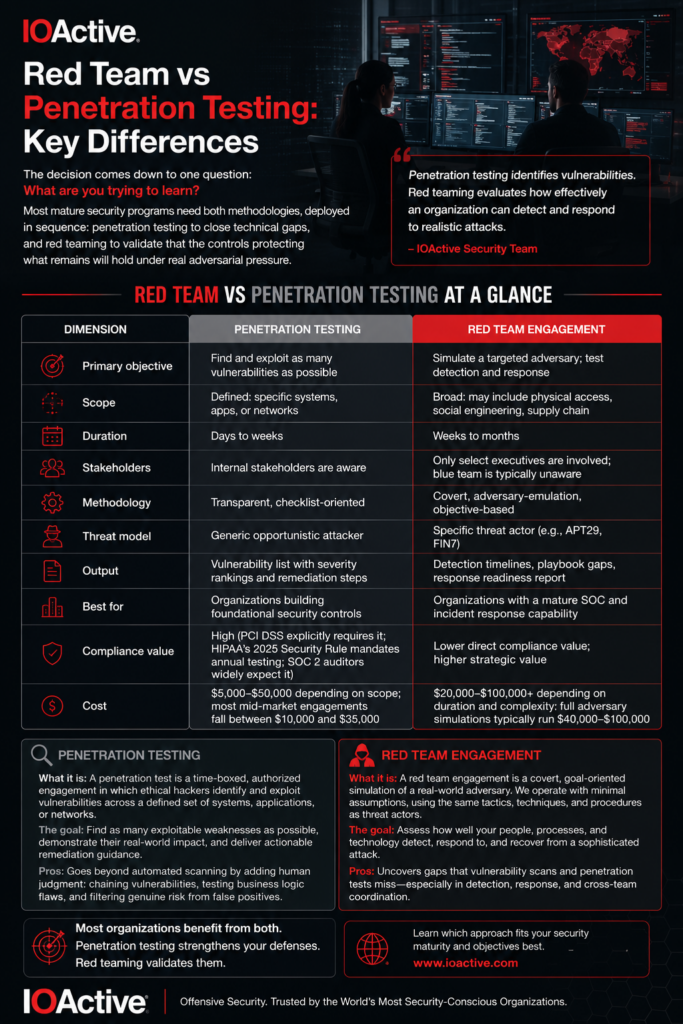
Red Team vs Penetration Testing: Key Differences

Red Team vs Penetration Testing: Key Differences breakdown graphic

“Penetration testing identifies vulnerabilities. Red teaming evaluates how effectively an organization can detect and respond to realistic attacks.” IOActive Security Team

The decision between red team vs penetration testing comes down to one question: What are you trying to learn? Most mature security programs need both methodologies, deployed in sequence: penetration testing to close technical gaps, and red teaming to validate that the controls protecting what remains will hold under real adversarial pressure.

This article breaks down the differences between red team vs penetration testing so your organization can choose the right approach.

Red Team vs Penetration Testing at a Glance

DimensionPenetration TestingRed Team Engagement
Primary objectiveFind and exploit as many vulnerabilities as possibleSimulate a targeted adversary; test detection and response
ScopeDefined: specific systems, apps, or networksBroad: may include physical access, social engineering, supply chain
DurationDays to weeksWeeks to months
StakeholdersInternal stakeholders are awareOnly select executives are involved; blue team is typically unaware
MethodologyTransparent, checklist-orientedCovert, adversary-emulation, objective-based
Threat modelGeneric opportunistic attackerSpecific threat actor (e.g., APT29, FIN7)
OutputVulnerability list with severity rankings and remediation stepsDetection timelines, playbook gaps, response readiness report
Best forOrganizations building foundational security controlsOrganizations with a mature SOC and incident response capability
Compliance valueHigh (PCI DSS explicitly requires it; the proposed HIPAA Security Rule update would mandate annual testing if finalized; SOC 2 auditors widely expect it)Lower direct compliance value; higher strategic value
Cost$5,000–$50,000 depending on scope; most mid-market engagements fall between $10,000 and $35,000$20,000–$100,000+ depending on duration and complexity; full adversary simulations typically run $40,000–$100,000

Penetration Testing

What it is: A penetration test is a time-boxed, authorized engagement in which ethical hackers identify and exploit vulnerabilities across a defined set of systems, applications, or networks.

The goal: Find as many exploitable weaknesses as possible, demonstrate their real-world impact, and deliver actionable remediation guidance.

Pros: Penetration testing goes beyond automated vulnerability scanning by adding human judgment: chaining vulnerabilities, testing business logic flaws, and filtering genuine risk from noise. Findings are immediately actionable.

Cons: Internal teams are typically aware the test is underway, which limits the value for measuring detection and response.

Choose a pentest when:

  • A compliance mandate requires it (PCI DSS, HIPAA, SOC 2 Type II)
  • You have deployed new infrastructure, applications, or cloud environments
  • You are validating remediation from a prior assessment
  • You are establishing your organization’s first formal testing program

Red Team Testing

What it is: A red team engagement is a full-scope adversarial simulation in which expert ethical hackers pursue specific objectives, such as accessing sensitive data or compromising executive accounts. Red team engagements use the same tactics, techniques, and procedures (TTPs) as real-world threat actors.

The goal: Determine whether your organization’s people, processes, and technology can detect, contain, and respond to a sophisticated attacker pursuing a specific objective, before a real adversary tests those same capabilities.

Pros: The engagement runs covertly, often without notifying the organization’s own security staff. This generates realistic data on detection timelines and incident response effectiveness.

Cons: Red team engagements are not optimized for cataloging technical vulnerabilities at scale. If foundational controls are weak, the red team will often achieve its objectives before meaningful detection data can be collected. In those cases, a penetration test would have surfaced the same findings faster and at lower cost.

Choose a red team engagement when:

  • Your SOC monitors alerts but has never been validated against a sophisticated intrusion
  • You need to test people and processes, not just technical controls
  • You want to measure detection and response against a specific, realistic threat scenario
  • Your security program has matured beyond foundational vulnerability management

Choose Based on Security Maturity

The most reliable decision factor is security maturity, which determines which question you are ready to answer. Organizations that have not yet closed known vulnerabilities will get more value from a pentest than from a red team engagement.

Organizations early in their security journey should run penetration tests first. If a red team can compromise your environment in hours without triggering a single alert, those findings could have been reached more efficiently with a pentest. Closing known vulnerabilities first allows a red team engagement to surface detection and response gaps that actually matter.

Security Maturity and Testing

Maturity StageIndicatorsRecommended Approach
FoundationalNo formal pentest history; basic patchingPenetration testing
DevelopingRegular pentests; security tooling in placePentesting + targeted red team scenarios
EstablishedFunctioning SOC, SIEM, incident response planBoth methodologies on a defined cadence
AdvancedMature threat intelligence; purple teaming capabilityRed team + purple team for continuous validation

Most organizations overestimate their maturity. If you have not run a penetration test within the past 12 months, or if your SOC has never responded to a simulated intrusion, a red team engagement will tell you less than a rigorous pentest will.

How the Two Methodologies Work Together

Penetration testing and red teaming are not competitors: they serve different stages of a security program. The typical progression is to run a pentest, remediate vulnerabilities, and build detection and response capabilities. From there, a red team engagement tests whether the SOC would detect a sophisticated attacker exploiting what remains.

Red team findings routinely drive improvements to SIEM detection rules, incident response playbooks, and security awareness training. It’s also recommended to use purple team exercises, which pair red team attackers with the organization’s blue team in a collaborative format to accelerate control tuning in real time.

Work With IOActive for Red Team Engagements and Penetration Testing

With over 25 years of offensive security research and engagements across some of the world’s most complex environments, IOActive has the experience to determine the right methodology for your risk profile and execute it with precision. IOActive’s penetration testing practice goes beyond off-the-shelf tooling, applying an attacker’s perspective and human judgment to chain vulnerabilities, expose business logic flaws, and deliver findings with clear remediation priority. Our red and purple team engagements run multi-vector, goal-based adversary simulations across technical, physical, and human attack surfaces, testing prevention, detection, response, and recovery under realistic conditions.

INSIGHTS | July 27, 2026

Iranian-Affiliated Actors Expand PLC Targeting to Siemens and Schneider Electric: What CISA’s Updated Advisory Means for CNI

Key Takeaways

  • On 22 July 2026, CISA, the FBI, NSA, and five other US agencies updated joint advisory AA26-097A, expanding the scope of an ongoing Iranian-affiliated campaign against internet-exposed PLCs from Rockwell Automation to now include Schneider Electric and Siemens devices [1].
  • The update adds a new exfiltration technique (MITRE ATT&CK T1041): actors are using vendors’ own legitimate engineering software to steal PLC project files from victim environments [1].
  • At one confirmed US victim, actors modified ladder logic to disable safety shutdown and alarm functions, allowing unsafe conditions to develop without alerting operators [1].
  • Government Services, Water and Wastewater Systems (WWS), and Energy sector organisations are named as directly affected; the multi-vendor scope means the realistic exposure is broader.
  • New IOCs and mitigation guidance are available, but the core weakness enabling this campaign — internet-exposed OT, often reachable via cellular modems — has been publicly known since at least April 2026 [1][4].

Why This Update Matters Now

Advisory AA26-097A is not a new warning — it was first published on 7 April 2026, when the authoring agencies (FBI, CISA, NSA, EPA, DOE, and US Cyber Command’s Cyber National Mission Force) disclosed active exploitation of internet-exposed Rockwell Automation/Allen-Bradley PLCs by an Iranian-affiliated group [1]. That group has been previously tracked under the CyberAv3ngers alias, tied to Iran’s IRGC Cyber Electronic Command, and is the same actor set implicated in the 2023 Unitronics PLC compromises across US water utilities [5].

The 22 July 2026 update adds new guidance on detecting malicious changes in reusable code modules exploited within Rockwell Automation PLC programs, and expands scope to include observed targeting of Schneider Electric, Siemens, and potentially other branded PLCs [1]. The Department of the Treasury also joined as a co-authoring agency, an addition worth noting given the financial-sector implications of Treasury’s involvement.

For CISOs overseeing critical national infrastructure, the update signals two things: the campaign has not been contained by the original advisory’s mitigations, and the actors’ targeting logic is protocol- and port-based rather than vendor-specific — meaning any internet-exposed PLC, regardless of manufacturer, is realistically in scope.

What Actually Changed in the Update

The July revision is substantive rather than cosmetic. Three additions stand out.

Expanded Manufacturer and Device Scope

The advisory now names specific targeted models: Rockwell’s CompactLogix and Micro850, Schneider Electric’s BMX P34/Modicon M340, and Siemens’ S7-1200 series. Inbound malicious traffic has been observed on ports associated with each vendor’s protocols — 44818 and 2222 for Rockwell, 102 for Siemens, and 502 for Modbus — alongside port 22 targeting on connected cellular modems [1].

A New Exfiltration Technique

For the first time, the advisory documents actors using the vendors’ own configuration software — Rockwell’s Studio 5000 Logix Designer, Schneider Electric’s EcoStruxure Control Expert, and Siemens’ TIA Portal — on leased, third-party infrastructure to pull device project files out of victim environments (MITRE ATT&CK T1041). This is a “living off the land” pattern: no exploit is required, because the tools used are the same ones legitimate engineers and integrators use daily [1].

Confirmed Safety-Logic Tampering

In one documented case, actors downloaded a malicious project file that preserved the PLC’s downstream ladder logic function but overrode the instruction sets responsible for maintaining safe operating parameters — disabling shutdown and alarm logic so operators would not be notified when the system entered an unsafe state. This is the detail that should reframe the conversation for CNI leaders: this is not credential theft or data exposure, it is a direct line to physical-process manipulation [1]. IOActive research has repeatedly shown how attackers can blind the humans in the loop: our study SCADA and Mobile Security in the IoT Era found that more than 20% of the vulnerabilities identified across dozens of ICS mobile applications could let an attacker misinform operators or influence the industrial process directly [7].

Who Is Affected by This Update?

Water and Wastewater Systems Operators

WWS remains a named sector, consistent with the actor group’s history since the 2023 Unitronics campaign [5]. Many WWS facilities rely on cellular-connected PLCs for remote pump stations and field sites — precisely the exposure pattern flagged in this advisory.

Energy Sector Asset Owners

Named alongside WWS, energy sector organisations running any of the three named vendors’ controllers should treat this as a direct exposure notice, not general awareness content.

Government Services and Facilities, Including Municipalities

Smaller municipal operators frequently lack the OT security maturity of larger CNI operators, and their PLC deployments may be exposed without an internal team fully aware of the risk.

Integrators and Managed Service Providers

The advisory specifically calls out that service providers may be maintaining internet connectivity to OT systems for remote monitoring purposes without being aware of active threat targeting — placing a burden on operators to proactively brief their vendors and MSPs [1].

Security Leaders in Adjacent Sectors

Rockwell, Schneider Electric, and Siemens PLCs are used far beyond the three named sectors — in manufacturing, transportation, and building automation. CISOs outside WWS, Energy, and Government Services should not assume this advisory doesn’t apply to them.

Open Questions and Risk Context

Independent research adds useful context the advisory itself doesn’t fully quantify. Censys identified 5,219 internet-exposed hosts globally responding to EtherNet/IP on port 44818 and self-identifying as Rockwell Automation/Allen-Bradley devices when the original advisory was published in April [3] — and a large share of that exposure traced back to cellular carrier networks rather than fixed corporate connections, indicating field-deployed devices such as pump stations and substations reachable through cellular modems as their sole path to the internet. Comparable exposure figures for Schneider Electric and Siemens devices under this expanded campaign have not yet been independently published at the time of writing; organisations should treat any current third-party exposure estimate for those vendors with appropriate caution.

It’s also worth flagging what the advisory explicitly does not claim: this is not a new vulnerability disclosure. The authoring agencies state that this activity reflects opportunistic targeting of exposed devices, not a vendor-specific flaw — device manufacturers are urged to adopt secure-by-default design, but no new CVE is attached to this update [1]. Organisations should not wait on a vendor patch; the primary mitigation is architectural (removing internet exposure), not a fix to be deployed.

Finally, attribution to a specific Iranian-affiliated group beyond the general IRGC-CEC/CyberAv3ngers lineage has not been formally re-confirmed in the July update — the advisory refers to “an Iranian-affiliated APT group” without reasserting the CyberAv3ngers name directly in the new content [1]. CISOs briefing boards should be precise about what is confirmed versus inferred from the group’s historical TTP overlap.

How IOActive Can Help

IOActive’s work in critical infrastructure spans the technical and strategic worlds of OT and ICS security, from the semiconductor inside a controller to the governance programme around it. Our team has operated in ICS environments since building the first proof-of-concept worm against the smart grid in 2009 [8], and has helped define standards and best practices including NIST 800-53 and 800-37. The services below map directly to the exposure pattern AA26-097A describes — internet-reachable PLCs, legitimate engineering tools turned against their owners, and safety logic that can be altered without detection.

Full Stack Security Assessments

Most providers scan at the network or application layer only. Our Full Stack assessments examine the entire environment, drilling down to the facility and silicon level and up through the personnel, process, and supply-chain layers around it. For the exposure this advisory describes, that means identifying internet-facing Rockwell, Schneider Electric, and Siemens controllers, testing the OT/IT boundary and the cellular-modem paths that so often provide the only route in, and — drawing on our hardware research background — examining the firmware and silicon of PLC and HMI devices themselves through penetration testing, reverse engineering, side-channel analysis, and fault injection. It is the same class of work behind our research Compromising Industrial Facilities from 40 Miles Away, which showed how a memory-corruption flaw in widely deployed industrial wireless automation devices could be exploited remotely to disable field sensor nodes — exactly the kind of remotely reachable field connectivity the advisory flags at cellular-connected pump stations and substations [6].

Red Team and Purple Team Services

The advisory’s most alarming detail — actors modifying ladder logic to disable safety shutdown and alarm functions without alerting operators — is exactly the scenario adversarial testing exists to surface. Our Red Team engagements emulate the tradecraft of the Iranian-affiliated actors described here, including the “living off the land” use of vendors’ own engineering software in place of exploits, while our Purple Team work translates those findings into measurable improvements in whether your monitoring would actually detect project-file tampering and unauthorised logic changes in time to act.

Supply Chain Integrity

AA26-097A places a specific burden on integrators and managed service providers maintaining remote connectivity to OT systems, and documents the vendors’ own configuration software — Studio 5000 Logix Designer, EcoStruxure Control Expert, and TIA Portal — being used as an exfiltration channel. Our Supply Chain Integrity service assesses the security posture of technology providers and critical third parties, reviewing firmware, embedded systems, remote-access arrangements, and procurement processes for inherited risk before it becomes an incident vector.

Secure Development Lifecycle

The advisory urges device manufacturers to adopt secure-by-default design rather than leaving operators to compensate for exposed controllers. For the vendors and OEMs in the PLC and HMI supply chain, our Secure Development Lifecycle work embeds security review into design and engineering — from threat modelling through code review and pre-release testing — so that the next generation of devices does not ship with the internet-reachable defaults this campaign depends on.

Advisory Services

Removing internet exposure is an architectural programme, not a one-time patch, and the advisory is explicit that there is no CVE to wait for. Our Advisory Services — spanning programmatic security review, security program development and management, and Virtual CISO support — help CISOs and boards turn this advisory into a prioritised remediation plan, brief leadership with precision about what is confirmed versus inferred regarding attribution, and build the incident readiness to respond if targeting is found in their environment.

  1. Inventory PLC exposure immediately. Identify all internet-facing Rockwell, Schneider Electric, and Siemens devices, prioritising the specifically named models (CompactLogix, Micro850, BMX P34/Modicon M340, S7-1200 series).
  2. Query logs against the July 2026 IOCs. Cross-reference the newly published STIX indicators against traffic logs for ports 44818, 2222, 102, and 502, and port 22 on connected cellular modems.
  3. Remove direct internet exposure. Route all remote access through a secure gateway or jump host; do not rely on the device’s built-in access controls alone.
  4. Validate project file integrity. Compare running logic against known-good baselines using vendor integrity tools, with particular attention to Add-On Instructions (AOIs) and safety/alarm logic.
  5. Brief integrators and MSPs directly. Confirm that any third party with remote access to your OT environment is aware of this advisory and has reviewed their own access paths.
  6. Set controllers to RUN mode where physically possible, switching to program mode only for authorised maintenance windows.

Conclusion

The expansion of AA26-097A from a single-vendor warning to a multi-vendor advisory in just over three months is a signal in itself: this is an active, adapting campaign, not a contained incident. For CNI security leaders, the technical specifics matter less than the underlying pattern — internet-exposed OT, reached through legitimate engineering tools, is producing real operational and financial consequences. The organisations that treat this as a one-time patching exercise will likely see a third update to this advisory before the underlying exposure problem is solved.

If you would like to discuss how your organisation’s PLC and control-system exposure measures up against the activity described in this advisory, or how IOActive can support your OT/ICS resilience programme, we welcome the conversation.

References

[1] CISA, FBI, NSA, EPA, DOE, CNMF, Department of the Treasury. Iranian-Affiliated Cyber Actors Exploit Programmable Logic Controllers Across US Critical Infrastructure (AA26-097A), updated 22 July 2026. https://www.ic3.gov/CSA/2026/260722.pdf

[2] WaterISAC. CISA Updates Iranian-Affiliated PLC Targeting Advisory (AA26-097A), 22 July 2026. https://www.waterisac.org/tlpclear-cisa-updates-iranian-affiliated-plc-targeting-advisory-aa26-097a

[3] Censys. Iranian-Affiliated APT Targeting of Rockwell/Allen-Bradley PLCs, April 2026. https://censys.com/blog/iranian-affiliated-apt-targeting-rockwell-allen-bradley-plcs/

[4] Cybersecurity Dive. Nearly 4K industrial control devices vulnerable to Iran-linked hacking campaign, 10 April 2026. https://www.cybersecuritydive.com/news/critical-infrastucture-plcs-iran-hacking-censys/817209/

[5] CISA. IRGC-Affiliated Cyber Actors Exploit PLCs in Multiple Sectors, Including US Water and Wastewater Systems Facilities (AA23-335A). https://www.cisa.gov/news-events/cybersecurity-advisories/aa23-335a

[6] IOActive. Compromising Industrial Facilities from 40 Miles Away (white paper). https://www.ioactive.com/wp-content/uploads/2018/05/IOActive_Compromising_Industrial_Facilities_from_40_Miles_Away.pdf

[7] IOActive (A. Bolshev, I. Yushkevich). SCADA and Mobile Security in the IoT Era. https://www.ioactive.com/scada-and-mobile-security-in-iot-era/

[8] M. Davis, IOActive. Advanced Metering Infrastructure (Smart Grid) Device Security, Black Hat USA 2009. https://blackhat.com/presentations/bh-usa-09/MDAVIS/BHUSA09-Davis-AMI-SLIDES.pdf

INSIGHTS | May 9, 2024

Always Updated Awards 2024 Blog

We are excited to announce that IOActive received multiple prestigious awards wins this year! Keep this blog bookmarked to always stay up-to-date on the company’s accomplishments throughout 2024.

Last updated September 30, 2024

IOActive was honored for its ability to maximize security investments and enhance clients’ overall security posture and business resilience. Unlike many organizations that default to defensive strategies, we at IOActive go beyond standard penetration testing to provide clients with red and purple team services that exceed typical assessments. We prioritize a comprehensive understanding of cyber adversaries through custom adversary emulation and ethical real-world attack simulations to develop robust, secure frameworks.

“We’re delighted to win awards in multiple categories throughout 2024,” said Jennifer Sunshine Steffens, CEO at IOActive. “These awards emphasize our nearly 30 years of leadership providing unique ‘attacker’s perspective’ methodologies that drive our research-fueled approach to security services trusted by Fortune 1000 companies worldwide.”

IOActive sets itself apart from the competition by bringing a unique attacker’s perspective to every client engagement, in order to maximize security investments and improve client’s overall security posture and business resiliency.

While many organizations focus on defense by ‘default,’ IOActive’s approach encourages secure-by-design practices and policies by introducing businesses to  an attacker’s mindset so that they can better understand the threat landscape.

Understanding our adversaries is crucial. Therefore, our penetration teams surpass standard penetration testing to offer our clients a range of red and blue team solutions that go beyond traditional approaches.

Check out our secured awards below:

2024 Corporate Excellence Awards

Best Research-Led Security Services Provider 2024 – USA

IOActive is a proud winner of this year’s ‘Best Research-Led Security Services Provider 2024 – USA’ through the implementation of up-to-date research embedded in the delivery of services. The Corporate Excellence Awards ‘showcase the companies and individuals that are committed to innovation, business growth, and providing the very best products and services to clients across a wide range of industries.’

2024 Cyber Security Excellence Awards

Pen Test Team of the Year

IOActive’s penetration testing team sets itself apart from the competition by bringing a unique attacker’s perspective to every client engagement in order to maximize security investments and improve client’s overall security posture and business resiliency.

Cybersecurity Team of the Year

At IOActive, our team provides more than traditional penetration testing. We freely share our security expertise through a range of offerings including red and purple team exercises, attack simulations, security consultancy, and our highly specialized technical and programmatic services.

In addition, our leaders and consultants, spearheaded by CEO Jennifer Sunshine Steffens, have

served long tenures in the cybersecurity field and are highly skilled in research, strategic security services, risk management, quality assurance, and regulatory requirements.

Cybersecurity Provider of the Year

IOActive is a worldwide leader in research-fueled security services implementing unique “attacker’s perspective” methodologies that form the foundation of the company’s global service offerings.

Whether our customers need guidance, on-the-ground penetration testing, or the assistance of a virtual CISO, we are committed to assuring client satisfaction.

We constantly strive to develop new ways to assist our customers in handling today’s complex threatscape and long component lifecycles. Every client engagement is tailored to maximize security investments and improve overall security postures and business resiliency.

2024 Global Infosec Awards

Trailblazing Cybersecurity Service Provider

Our team has conducted groundbreaking research within a variety of industries, including research into the Boeing airplane’s network, uncovering vehicle vulnerabilities by hacking into a Jeep, a card shuffler machine and much more.

Our security services, spanning across the silicon and hardware-based levels to real-world attack simulations, demonstrate our expertise in ensuring organizations achieve security resilience.

Just as each cyberattacker and threat is different, we ensure our services are tailored to the needs of our clients – and we take pride in exceeding expectations, every time.

Trailblazing Cybersecurity Research

Our diverse cybersecurity team, with a presence in over 30 countries worldwide, combines decades of experience with cutting-edge research to develop innovative security solutions suitable for a broad range of industries and companies.

We count Fortune 1000 organizations among our customers, and we provide research-backed services across industries including automotive, medical devices, aviation, and satellite communications. Overall, we are deeply committed to offering unrelenting value and support internationally and to all of our customers.

COLLATERAL | April 22, 2020

IOActive Corporate Overview

Research-fueled Security Assessments and Advisory Services

IOActive has been at the forefront of cybersecurity and testing services since 1998. Backed by our award-winning research, our services have been trusted globally by enterprises and product manufacturers across a wide variety of industries and in the most complex of environments.

Tailored to meet each unique organization’s requirements, IOActive services offer deep expertise and insight from an attacker’s perspective. 

COLLATERAL | April 17, 2020

IOActive Red and Purple Team Service

Building Operational Resiliency Through Real-world Threat Emulation.

Who better to evaluate security effectiveness – compliance auditors or attackers? Vulnerability assessments and penetration tests are critical components of any effective security program, but the only real way to test your operational resiliency is from an attacker’s perspective.

Our red and purple teams bring you this insight through full threat emulation, comprehensively simulating a full range of specific attacks against your organization – cyber, social, and physical.
We can provide or advise on the creation of continuous, independent, and customized real-world attacker-emulation services that work with your blue team – your own security operations personnel – to prepare them to face the adversaries your enterprise is likeliest to encounter.


COLLATERAL |

IOActive Services Overview

Security services for your business, situation, and risks.

With our breadth and depth of services offerings across more environments than any other firm today, we can deliver specific, high-value recommendations based on your business, unique situation, and the risk you face. We are a pure-play security services provider, offering services across the spectrum to include: cybersecurity advisory, full-stack security assessments, SDL, red/purple team and security team development (training) services.

ADVISORIES | April 23, 2018

HooToo Security Advisory

HT-TM05 is vulnerable to unauthenticated remote code execution in the /sysfirm.csp CGI endpoint, which allows an attacker to upload an arbitrary shell script that will be executed with root privileges on the device. (more…)

ADVISORIES | October 17, 2017

Microsoft Kernel Graphic Driver Kernel Memory Address Disclosure

The latest version of Microsoft Basic Render Driver (BasicRender.sys 10.0.15063.413) is vulnerable to information disclosure. This issue allows an unprivileged user to map the kernel memory layout. (more…)